
A hug in your computer
One of the largest employee assistance providers (EAP) in Canada has launched an online counselling service for people who would rather discuss personal problems over e-mail than meet face-to-face with a counsellor.
Warren Shepell Consultants Corp., which has 1,300 clients in North America, rolled out the innovative service October 1, giving clients that already have an EAP the option to sign up for the service designed for short term counselling.
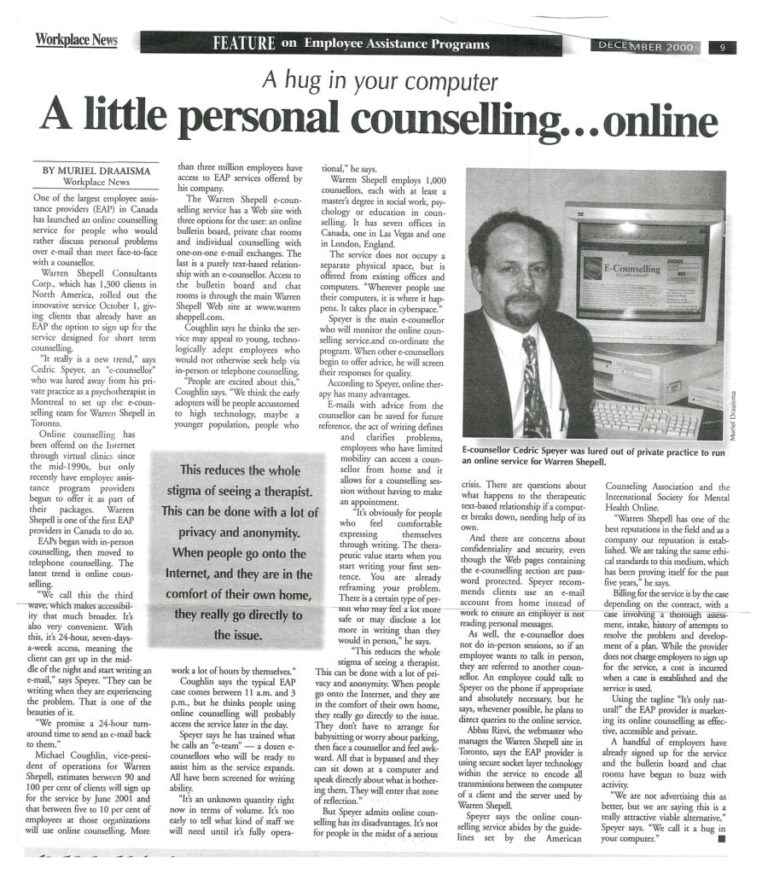
“It really is a new trend,” says Cedric Speyer, an “e-counsellor” who was lured away from his private practice as a psychotherapist in Montreal to set up the e-counselling team for Warren Shepell in Toronto.
Online counselling has been offered on the Internet through virtual clinics since the mid-1990s, but only recently have employee assistance program providers begun to offer it as part of their packages. Warren Shepell is one of the first EAP providers in Canada to do so.
EAPs began with in-person counselling, then moved to telephone counselling. The latest trend is online counselling.
“We call this the third wave, which makes accessibility that much broader. It’s also very convenient. With this, it’s 24-hour, seven-days-a-week access, meaning the client can get up in the middle of the night and start writing an e-mail,” says Speyer. “They can be writing when they are experiencing the problem. That is one of the beauties of it.
“We promise a 24-hour turnaround time to send an e-mail back to them.”
Michael Coughlin, vice-president of operations for Warren Shepell, estimates between 90 and 100 per cent of clients will sign up for the service by June 2001 and that between five to 10 per cent of employees at those organizations will use online counselling. More than three million employees have access to EAP services offered by his company.
The Warren Shepell e-counselling service has a Web site with three options for the user: an online bulletin board, private chat rooms and individual counselling with one-on-one e-mail exchanges. The last is a purely text-based relationship with an e-counsellor. Access to the bulletin board and chat rooms is through the main Warren Shepell Web site at www.warrenshepell.com.
Coughlin says he thinks the service may appeal to young, technologically adept employees who would not otherwise seek help via in-person or telephone counselling.
“People are excited about this,” Coughlin says. “We think the early adopters will be people accustomed to high technology, maybe a younger population, people who work a lot of hours by themselves.”
Coughlin says the typical EAP case comes between 11 a.m. and 3 p.m., but he thinks people using online counselling will probably access the service later in the day.
Speyer says he has trained what he calls an “e-team” — a dozen e-counsellors who will be ready to assist him as the service expands. All have been screened for writing ability.
“It’s an unknown quantity right now in terms of volume. It’s too early to tell what kind of staff we will need until it’s fully operational,” he says.
Warren Shepell employs 1,000 counsellors, each with at least a master’s degree in social work, psychology or education in counselling. It has seven offices in Canada, one in Las Vegas and one in London, England.
The service does not occupy a separate physical space, but is offered from existing offices and computers. “Wherever people use their computers, it is where it happens. It takes place in cyberspace.”
Speyer is the main e-counsellor who will monitor the online counselling service and co-ordinate the program. When other e-counsellors begin to offer advice, he will screen their responses for quality.
According to Speyer, online therapy has many advantages.
E-mails with advice from the counsellor can be saved for future reference, the act of writing defines and clarifies problems, employees who have limited mobility can access a counsellor from home and it allows for a counselling session without having to make an appointment.
“It’s obviously for people who feel comfortable expressing themselves through writing. The therapeutic value starts when you start writing your first sentence. You are already reframing your problem. There is a certain type of person who may feel a lot more safe or may disclose a lot more in writing than they would in person,” he says.
“This reduces the whole stigma of seeing a therapist. This can be done with a lot of privacy and anonymity. When people go onto the Internet, and they are in the comfort of their own home, they really go directly to the issue. They don't have to arrange for babysitting or worry about parking, then face a counsellor and feel awkward. All that is bypassed and they can sit down at a computer and speak directly about what is bothering them. They will enter that zone of reflection.”
But Speyer admits online counselling has its disadvantages. It’s not for people in the midst of a serious crisis. There are questions about what happens to the therapeutic text-based relationship if a computer breaks down, needing help of its own.
And there are concerns about confidentiality and security, even though the Web pages containing the e-counselling section are password protected. Speyer recommends clients use an e-mail account from home instead of work to ensure an employer is not reading personal messages.
As well, the e-counsellor does not do in-person sessions, so if an employee wants to talk in person, they are referred to another counsellor. An employee could talk to Speyer on the phone if appropriate and absolutely necessary, but he says, wherever possible, he plans to direct queries to the online service.
Abbas Rizvi, the webmaster who manages the Warren Shepell site in Toronto, says the EAP provider is using secure socket layer technology within the service to encode all transmissions between the computer of a client and the server used by Warren Shepell.
Speyer says the online counselling service abides by the guidelines set by the American Counseling Association and the International Society for Mental Health Online.
“Warren Shepell has one of the best reputations in the field and as a company our reputation is established. We are taking the same ethical standards to this medium, which has been proving itself for the past five years,” he says.
Billing for the service is by the case depending on the contract, with a case involving a thorough assessment, intake, history of attempts to resolve the problem and development of a plan. While the provider does not charge employers to sign up for the service, a cost is incurred when a case is established and the service is used.
Using the tagline “It’s only natural!” the EAP provider is marketing its online counselling as effective, accessible and private.
A handful of employers have already signed up for the service and the bulletin board and chat rooms have begun to buzz with activity.
“We are not advertising this as better, but we are saying this is a really attractive viable alternative,” Speyer says. “We call it a hug in your computer.”
Pull quote: “This reduces the whole stigma of seeing a therapist. This can be done with a lot of privacy and anonymity. When people go onto the Internet, and they are in the comfort of their own home, they really go directly to the issue.”
Photo caption: E-counsellor Cedric Speyer was lured out of private practice to run an online service for Warren Shepell. (Photo: Muriel Draaisma)