
Virginia Galt discovers allure of on-line help
Is stress affecting your work and causing sleepless nights? There’s help now in cyberspace: the e-counsellor is in.
The latest in employee assistance allows clients to spell out their problems in e-mail messages to counsellors who have been trained to deal with angst pouring into their in-boxes.
“We call them the e-team,” says social worker Michael Coughlin, vice-president and director of clinical services at Warren Shepell Consultants Corp., one of Canada’s leading providers of employee assistance programs.
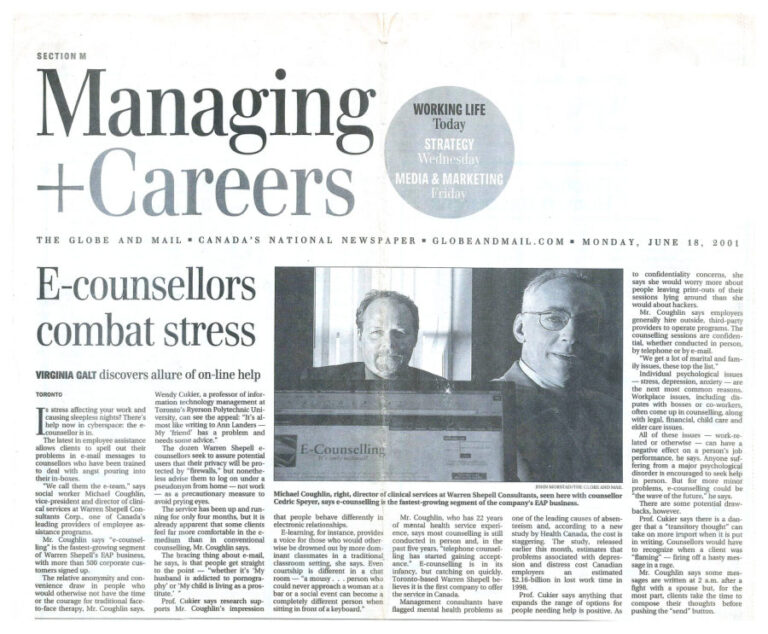
Mr. Coughlin says “e-counselling” is the fastest-growing segment of Warren Shepell’s EAP business, with more than 500 corporate customers signed up.
The relative anonymity and convenience draw in people who would otherwise not have the time or the courage for traditional face-to-face therapy, Mr. Coughlin says.
Wendy Cukier, a professor of information technology management at Toronto’s Ryerson Polytechnic University, can see the appeal: “It’s almost like writing to Ann Landers — My ‘friend’ has a problem and needs some advice.”
The dozen Warren Shepell e-counsellors seek to assure potential users that their privacy will be protected by “firewalls,” but nonetheless advise them to log on under a pseudonym from home — not work — as a precautionary measure to avoid prying eyes.
The service has been up and running for only four months, but it is already apparent that some clients feel far more comfortable in the e-medium than in conventional counselling, Mr. Coughlin says.
The bracing thing about e-mail, he says, is that people get straight to the point — “whether it’s ‘My husband is addicted to pornography’ or ‘My child is living as a prostitute.’ ”
Prof. Cukier says research supports Mr. Coughlin’s impression that people behave differently in electronic relationships.
E-learning, for instance, provides a voice for those who would otherwise be drowned out by more dominant classmates in a traditional classroom setting, she says. Even courtship is different in a chat room — “a mousy… person who could never approach a woman at a bar or a social event can become a completely different person when sitting in front of a keyboard.”
Mr. Coughlin, who has 22 years of mental health service experience, says most counselling is still conducted in person and, in the past five years, “telephone counselling has started gaining acceptance.” E-counselling is in its infancy, but catching on quickly. Toronto-based Warren Shepell believes it is the first company to offer the service in Canada.
Management consultants have flagged mental health problems as one of the leading causes of absenteeism and, according to a new study by Health Canada, the cost is staggering. The study, released earlier this month, estimates that problems associated with depression and distress cost Canadian employers an estimated $2.16-billion in lost work time in 1998.
Prof. Cukier says anything that expands the range of options for people needing help is positive. As to confidentiality concerns, she says she would worry more about people leaving print-outs of their sessions lying around than she would about hackers.
Mr. Coughlin says employers generally hire outside, third-party providers to operate programs. The counselling sessions are confidential, whether conducted in person, by telephone or by e-mail.
“We get a lot of marital and family issues, these top the list.”
Individual psychological issues — stress, depression, anxiety — are the next most common reasons. Workplace issues, including disputes with bosses or co-workers, often come up in counselling, along with legal, financial, child care and elder care issues.
All of these issues — work-related or otherwise — can have a negative effect on a person’s job performance, he says. Anyone suffering from a major psychological disorder is encouraged to seek help in person. But for more minor problems, e-counselling could be “the wave of the future,” he says.
There are some potential drawbacks, however.
Prof. Cukier says there is a danger that a “transitory thought” can take on more import when it is put in writing. Counsellors would have to recognize when a client was “flaming” — firing off a hasty message in a rage.
Mr. Coughlin says some messages are written at 2 a.m. after a fight with a spouse but, for the most part, clients take the time to compose their thoughts before pushing the “send” button.
Photo caption: Michael Coughlin, right, director of clinical services at Warren Shepell Consultants, seen here with counsellor Cedric Speyer, says e-counselling is the fastest-growing segment of the company’s EAP business. (John Morstad / The Globe and Mail)